
Follow-Up & Speed · Lead Quality
The 5-Minute Problem Costing Contractors Thousands of Dollars
By Kent Dong · Published August 17, 2026 · Updated August 17, 2026
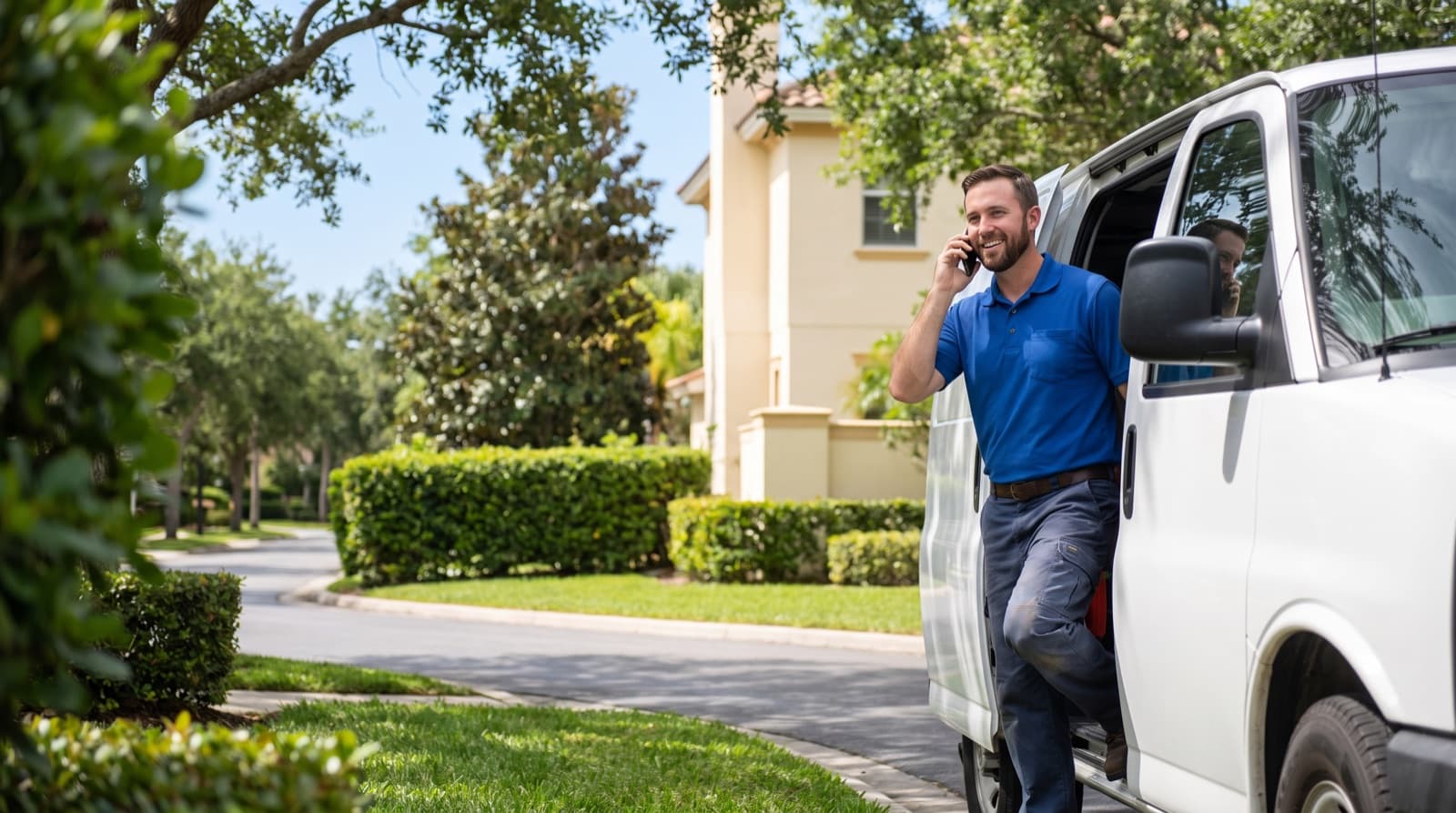
Speed-to-lead is the time between a customer's inquiry and your first real contact with them. In home services it's one of the largest performance levers available, it costs almost nothing to fix, and most companies are losing jobs to it without ever seeing the loss on a report.
Here's a scene that plays out in Orange County a few hundred times a day.
A homeowner's water heater starts leaking. She sits down with her phone, searches, and fills out forms on four contractors' websites in about eight minutes. Then she puts the phone down and goes back to her afternoon.
- Contractor #1 gets the lead in an inbox nobody checks until the end of the day. He calls the next morning.
- Contractor #2 sees the notification 45 minutes later between jobs and calls back.
- Contractor #3 has an automated text go out within 60 seconds — "Hi Sarah, this is Mike with [Company], I just got your note about the water heater leak. Is now an okay time for a quick call?" — and calls four minutes after that.
- Contractor #4 never responds at all. It happens more than you'd think.
Who gets the estimate?
Contractor #3, almost every time. And here's the part that stings: he might be the third-best of the four at the actual work.
Why the first call wins so decisively
It isn't that being fast makes you better. It's that being first changes the shape of the entire decision.
You catch her while she's still deciding. When she filled out those forms, the leak was the most important thing in her day. Four minutes later, it still is. Twenty-four hours later, she's already handled it or already committed to someone.
You set the frame. The first contractor to talk to her explains what causes the failure, what the options are, and what a fair range looks like. Every conversation after that gets measured against his explanation. He wrote the test the other three have to take.
Fast response is read as competence. She has no way to evaluate anyone's plumbing. She absolutely can evaluate who called back fast. That's the only performance data she has, so she uses it — and she's not wrong to. A company that responds in four minutes is usually a company that shows up when it says it will.
She stops shopping. People don't run a full comparison out of enthusiasm. They do it because they're unsure. Once someone credible has answered their questions, the urge to keep researching drops sharply.
The loss doesn't show up on your reports
This is why speed-to-lead goes unfixed for years. It never appears as a line item.
Your ad account says you got 30 leads. Your sales log says you closed 4. Nothing anywhere says "9 of those leads were called the next day, and 7 of them had already hired someone."
So the conversation becomes "our leads are bad" or "the ads aren't working." The ads worked fine. The ads delivered someone who wanted to buy. She just bought from someone who picked up first.
| What it looks like | What owners usually conclude | What's often actually happening |
|---|---|---|
| Leads don't answer the phone | Lead quality is poor | First call went out hours after the inquiry, when interest had already moved on |
| Leads say they 'went with someone else' | We're too expensive | A competitor framed the decision before you got a turn |
| Cost per lead is fine, close rate is bad | The ads attract tire-kickers | The pipeline leaks between inquiry and first contact, not at the ad |
| Weekend leads never convert | Weekend traffic is junk | Nobody responds until Monday, by which point the job is booked |
The fix is boring, which is why it works
You don't need new software as much as you need a rule that doesn't depend on anyone remembering.
Every inquiry gets acknowledged within five minutes, automatically. A text, by name, referencing what they asked about. Not a generic auto-reply — those read as a machine and lower trust. Something a person would plausibly type. This alone holds a lead in place while you finish what you're doing.
Every inquiry gets a human call attempt the same day. Ideally within the hour. If the first attempt misses, a second attempt happens later the same day, not tomorrow.
Nothing lives in an inbox. Email is where leads go to die. Inquiries should land somewhere that pushes a notification to a phone and won't let the lead sit unassigned. That's the honest argument for a CRM — not the reporting, not the pipeline stages, just the fact that it refuses to lose things.
Someone owns the number. If everyone is responsible for lead response, nobody is. One person, one rule, one place it gets tracked.
Measure it. Time from form submission to first outbound contact, averaged weekly. It's the easiest metric in your business to move and one of the most profitable. You'll know within two weeks whether the rule is real or aspirational.
A note on automation
Automation gets oversold in home services, usually by people selling the software. So be clear about what it's for.
Automation is not there to have the conversation. It's there to hold the door open for the four to forty minutes it takes you to get off a roof, out of a crawlspace, or off another call. It buys you time. The human call still closes the job.
The version that fails is the one where a contractor sets up an elaborate sequence of eleven automated messages and stops calling people. The version that works is one text, sent immediately, followed by a real person as soon as humanly possible.
What it's worth
Do the arithmetic for your own business. Take your monthly lead count, estimate what portion currently go 12+ hours before first contact, and assume you'd close even a modest share of those with a faster first touch. Multiply by your average job value.
For most contractors doing meaningful volume, that number is larger than their entire monthly ad budget.
Which means the cheapest growth available to a lot of home service businesses isn't more leads, better creative, or a bigger budget. It's answering the ones they already paid for before someone else does.
FAQ
Within five minutes if at all possible, and within the same hour at worst. Homeowners typically contact several companies at once, and the first business to reach them frames the entire comparison — often before the others have even seen the inquiry.
It changes who gets to compete at all. A lead you reach in five minutes is still in the mindset that made them submit the form. A lead you reach the next day has already talked to someone else, has a quote to compare against, and is evaluating you as the second opinion.
Automate the first touch. An immediate text acknowledging the inquiry by name and service, followed by a call as soon as you're free, holds the lead long enough to matter. The goal isn't a full conversation in five minutes — it's proof that a real business received the request.
You need something that catches every inquiry and triggers an immediate response — that's usually a CRM, but a simpler setup can work. The tool matters less than the rule: every lead gets acknowledged within minutes and called the same day, without depending on anyone remembering.

Kent Dong
Founder & Lead Strategist, KVM Creative Agency